Conversations with Destiny: The Story of Gai Eaton
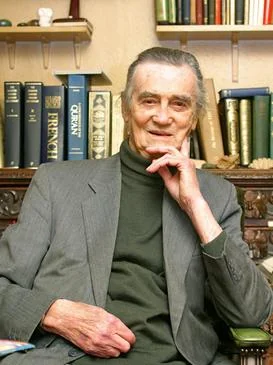
Gai Eaton
30 years old, from United Kingdom
Previous Religion: Agnosticism
My Life Before Islam
Charles le Gai Eaton was born on January 1, 1921, in Lausanne, Switzerland, and raised in a London home without religion, absorbing the scepticism of his age. He was educated at Charterhouse and then King's College, Cambridge, where he studied history, and while still at university he published a novel titled "The Vertical Ladder." Life in the intellectual circles of England left him restless and adrift, and after graduating he set out into the wider world, serving as a lawyer in Jamaica and travelling across the Americas. His was a search driven not by nostalgia but by a sense that the modern world had lost its way, and he was determined to find what it had lost.
The Moment of Guidance
During the 1940s and 1950s Eaton became increasingly interested in the religions of the East and began to study comparative religion seriously. A decisive encounter came in the mid-1940s through the teachings of Frithjof Schuon, the Swiss philosopher of the perennialist school, whose writings opened a door into the world of esoteric Islam. Encouraged by his friend Martin Lings, himself a famous convert, Eaton travelled to Egypt in 1951 and there, at the age of thirty, he embraced Islam, taking the name Hasan Abdul Hakeem. Years later he described the decision not as a rejection of his past but as the answer to a search that had governed his entire life.
Reflections
In 1951, while living in Egypt, Gai Eaton entered Islam and took the name Hasan Abdul Hakeem, guided by the mentoring of Martin Lings and through the teachings of Schuon. The moment came quietly, as the climax of years of study rather than a sudden flash, yet it redirected his whole existence. From Catholic-majority France and secular England he moved into the heart of the Muslim world, first in Cairo and later in Pakistan, where he served as an adviser. He would later write that he had been a Muslim in spirit long before he pronounced the shahada, and that his Islam gave his life a centre it had previously lacked.
Gai Eaton spent two decades as a British diplomat, serving from 1959 to 1977 in the Foreign Service with postings across the Muslim world, and then served for twenty-two years as a consultant to the Islamic Cultural Centre at the Regent's Park Mosque in London. He is best remembered as the author of "King of the Castle," "Islam and the Destiny of Man," "Remembering God" and his autobiography "A Bad Beginning," works that have guided countless wanderers toward Islam. In 1975 he joined the Darqawiyya Alwiyya tariqa, and he remained with it until his death on February 26, 2010. He is buried at Brookwood Cemetery in Surrey.